Five branded booking sites on one payments engine
How a motorsports booking platform serves five white-label venues from one shared reservation and Stripe payments engine, and what that design costs.
Azeem Subhani · · 5 min read
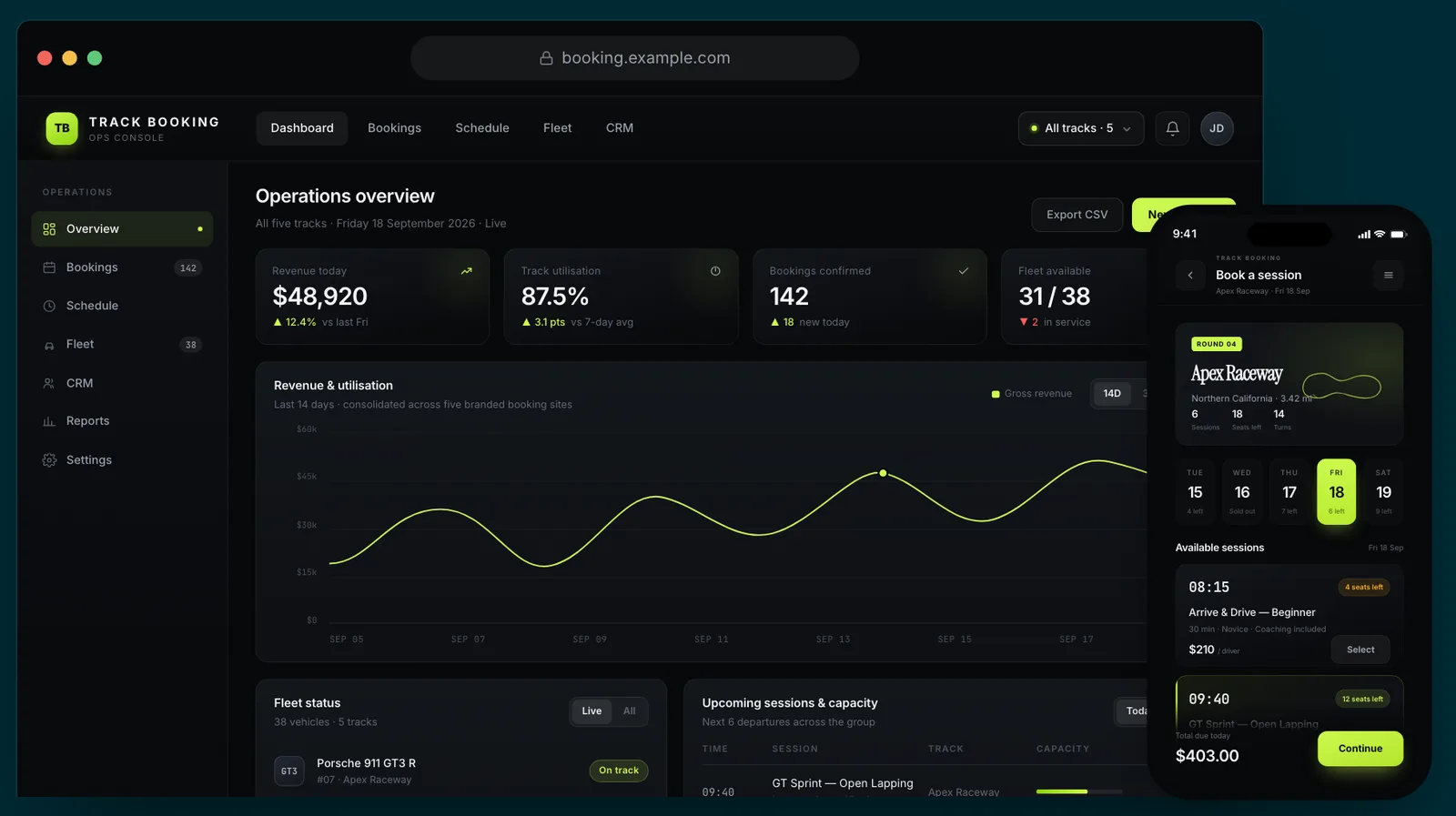
Motorsports venues sell an odd mix of things: track time, driving experiences, events, gift certificates. Each one wants a booking site that looks like its own brand, and none of them wants to pay for, or maintain, a separate reservation and payments system.
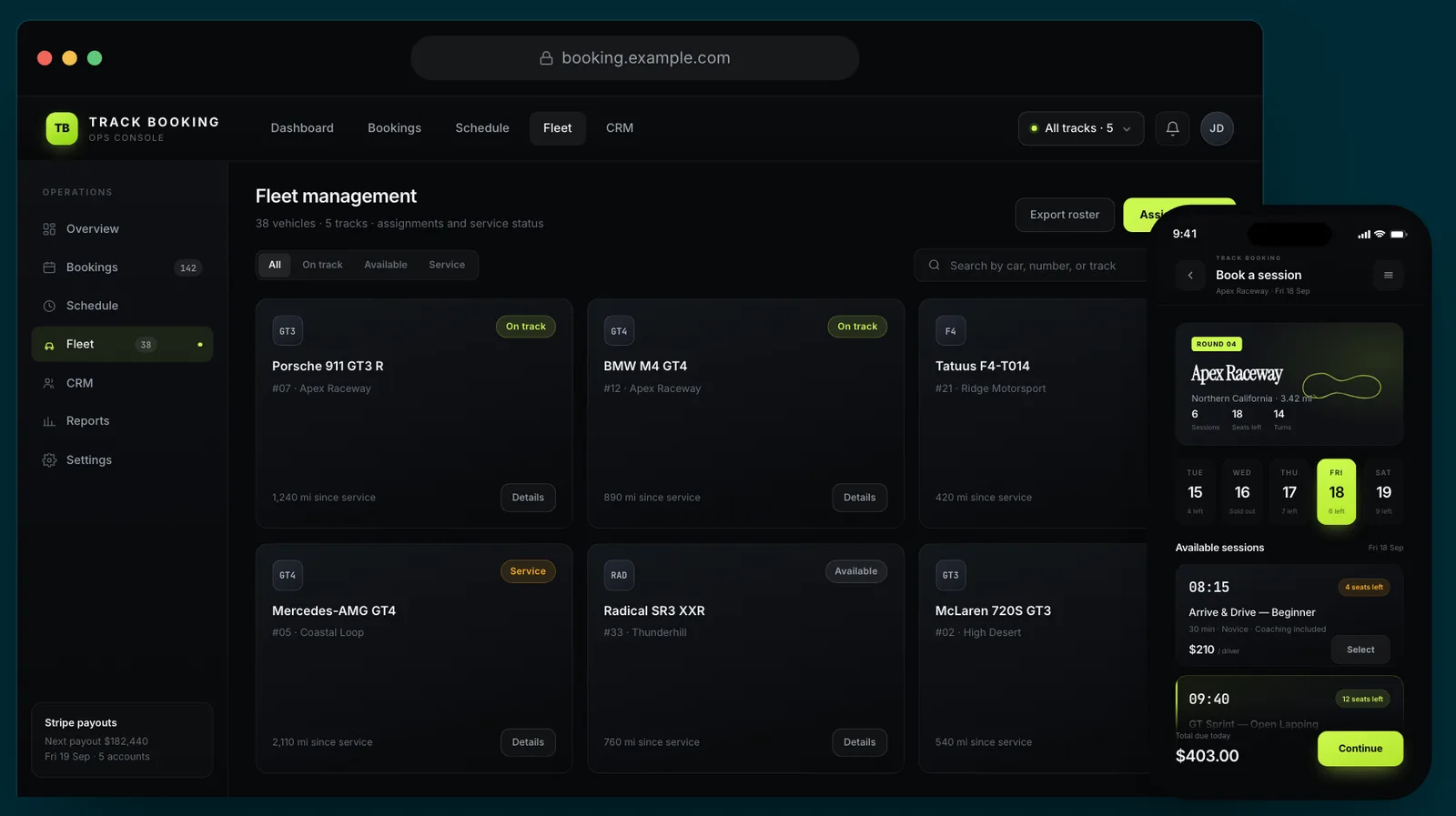
On the Track Booking Platform I built customer booking flows and the operator back office for five venues. Each venue runs its own branded booking site, and all five share one reservation and payments engine.
This post covers why that shape works, what has to be shared and what can vary, and the costs you take on when five businesses depend on one codebase.
The shape of the system
From the outside, there are five booking sites. Underneath, there is one product:
- One frontend codebase in React, Next.js, and TypeScript renders every venue's customer site.
- One Django API owns reservations, CRM, fleet, and event scheduling for every venue.
- One database and one Stripe integration sit behind it.
The operator back office runs on the same engine. Staff work with reservations, CRM, fleet management, event scheduling, payments, and reporting in one console instead of five.
Why one engine
The alternative is a stack per venue: copy the codebase, change the logo, deploy it again. It's the fastest way to launch venue number two. By venue five, it's the slowest way to do anything else.
With five copies, every bug fix ships five times, and so does every Stripe change and every new product type. The copies drift apart, because a fix that's urgent for one venue rarely gets backported to the other four on the same day. Within a year, "the booking system" is really five slightly different booking systems.
With a shared engine, a new venue is configuration, not a fork.
What varies per venue
The question that shapes the whole design is: what is actually different between venues? In a booking business it's usually less than it first looks. Here's how I split it:
- Brand: name, colors, logo, imagery, and the copy on the customer site.
- Catalog: the sessions, experiences, and events the venue sells, and their prices.
- Operations: the venue's fleet, schedule, and staff, all visible in the back office.
Everything else is the engine: how availability is calculated, how a checkout works, how a refund flows back, and how a report adds up. Those behave the same for every venue, because they're the parts that are expensive to get wrong.
In code, the per-venue part should be a typed object rather than conditionals scattered through components. The shape below is illustrative, but the principle is the one that matters:
// Illustrative. Everything a venue can change lives here, typed.
// If a request doesn't fit this shape, it isn't configuration (see "Special cases").
type VenueConfig = {
  slug: string;
  brand: {
    name: string;
    logo: string;
    colors: { primary: string; surface: string };
  };
  catalog: {
    currency: "USD";
    productTypes: Array<"track-time" | "experience" | "event" | "gift-certificate">;
  };
  checkout: {
    allowPromoCodes: boolean;
    allowGiftCertificates: boolean;
  };
};
The payments surface
Payments is where a shared engine pays off most. Stripe covers the platform's whole transaction surface:
- reservations
- stored cards for returning customers
- gift certificates
- account credits
- promo codes
Each one is easy to get slightly wrong. A gift certificate that can be redeemed twice is a real loss. So is a promo code that stacks when it shouldn't, or a credit that gets applied after the card has already been charged. These are exactly the bugs you don't want to fix five times.
The rule I hold to: every instrument resolves to one amount due on the server before a card is touched. The browser can show a running total, but the API computes the real one. That way there's exactly one place where discounts, balances, and credits combine, and one place to test.
Keeping venues apart
Sharing an engine means sharing tables. Every reservation, customer, vehicle, and payout row belongs to exactly one venue, and every query has to respect that. The failure mode is quiet: a report that adds up another venue's revenue, or a customer search that returns someone from across town.
I don't leave that to each developer to remember. Scope by venue at the lowest layer you can, so the default query is already safe:
# Illustrative Django pattern: querysets are venue-scoped unless you opt out.
class VenueQuerySet(models.QuerySet):
    def for_venue(self, venue):
        return self.filter(venue=venue)


class Reservation(models.Model):
    venue = models.ForeignKey("venues.Venue", on_delete=models.PROTECT)
    # ...

    objects = VenueQuerySet.as_manager()


# In views and API handlers, the venue comes from the request, never the payload.
def list_reservations(request):
    return Reservation.objects.for_venue(request.venue).order_by("starts_at")
Group-level reporting is the deliberate exception. It's still a real feature, because an operator does want "revenue across all five venues." But it should be explicit and permission-checked, never the default.
What it costs
A shared engine isn't free. These are the trade-offs worth planning for from day one:
- Blast radius. A bad deploy reaches every venue at once. Staged rollouts, error monitoring, and a fast rollback stop being optional.
- Tenant isolation. Covered above. It has to be enforced by the design, and tested, because the bug is invisible until it's embarrassing.
- Shared release cadence. Venue A can't stay on last month's checkout while venue B gets the new one, unless you build that switch on purpose.
- The pull toward special cases. Covered next. It's the cost that quietly turns one engine back into five.
Special cases
Sooner or later one venue asks for something nobody else wants. How you answer decides whether the engine survives. My default flow:
Most requests turn out to be configuration once you ask what the venue actually needs: different copy, a different cut-off time, a pricing rule. The rest usually help more than one venue, so they become a feature that's off by default. What's left gets a real conversation about whether it belongs in the engine at all.
When to choose this
If you run several brands, locations, or franchisees on the same business model, a shared engine with per-brand configuration is usually the right default. The extra discipline it takes up front, a typed config, venue-scoped data, and a server-side total, costs far less than keeping parallel systems in sync later.
It's the wrong choice when the businesses don't actually share a model. If one venue sells memberships and another sells one-off events, forcing them into one engine leads to the special-case problem on day one.
Planning something similar? Get in touch.
Written by
Azeem Subhani
Senior Full-Stack & AI Application Engineer
I build SaaS, booking, payment, real-time, and AI-enabled web platforms with React, Next.js, Node.js, NestJS, Django, PostgreSQL, and AWS. My work includes Stripe payment systems, white-label booking flows, real-time collaboration, RAG workflows, and developer automation.